
Most adults have between 10 and 40 moles. Almost all of them are harmless and stay the same for years. Melanoma, the most serious type of skin cancer, can start in an existing mole, but it more often appears as a new spot on the skin. Knowing what your moles normally look like makes it easier to notice a change early, when treatment is simplest.
At Aura Medical Clinic in Tirana, moles and other skin growths are assessed by Dr. Gloria Hoxhallari, a doctor in specialist training in dermatology and venereology whose training includes dermoscopy and the early diagnosis of skin cancer. This article explains how a harmless mole usually looks, which changes are warning signs and when to have a mole checked.
Harmless mole or warning sign: a comparison
| What to look at | Usually harmless | Have it checked |
|---|---|---|
| Shape (A: asymmetry) | Round or oval; both halves look alike. | One half looks different from the other. |
| Border (B) | Smooth, clear edge. | Irregular, notched or blurred edge. |
| Colour (C) | One even shade of brown. | Several shades, such as brown, black, red, white or blue. |
| Size (D: diameter) | Usually smaller than 6 mm, about the size of a pencil eraser. | Larger than 6 mm, or getting bigger. Melanoma can also be smaller. |
| Change (E: evolution) | Stays the same over months and years. | Changes in size, shape or colour, or becomes raised. |
| Symptoms | No symptoms. | Itching, bleeding, crusting or a sore that does not heal. |
| Compared with your other moles | Looks like your other moles. | Looks different from all the others (the “ugly duckling” sign). |
The first five rows are known as the ABCDE rule. One warning sign does not mean that a mole is cancer, but it is a reason to have it examined by a doctor.
Who should check their skin more often
- People with many moles (more than 50) or with large, irregular moles.
- People with fair skin, light eyes, red or blond hair, freckles or skin that burns easily.
- People who have had sunburns, especially blistering sunburns in childhood, or who have used sunbeds.
- People whose parent, brother, sister or child has had melanoma.
- People who have already had a skin cancer, or whose immune system is weakened, for example after an organ transplant.
How to check your skin at home
Once a month, check your whole skin in good light, using a full-length mirror and a hand mirror. Include the scalp, the back, the soles of the feet, the skin between the toes, the nails and the genital area, and ask someone to help with the places you cannot see. Taking photos of your moles makes it easier to compare them over time. Melanoma can also appear in places that get little sun, including the palms, the soles and under the nails, where it can look like a new dark line.
What happens at the consultation
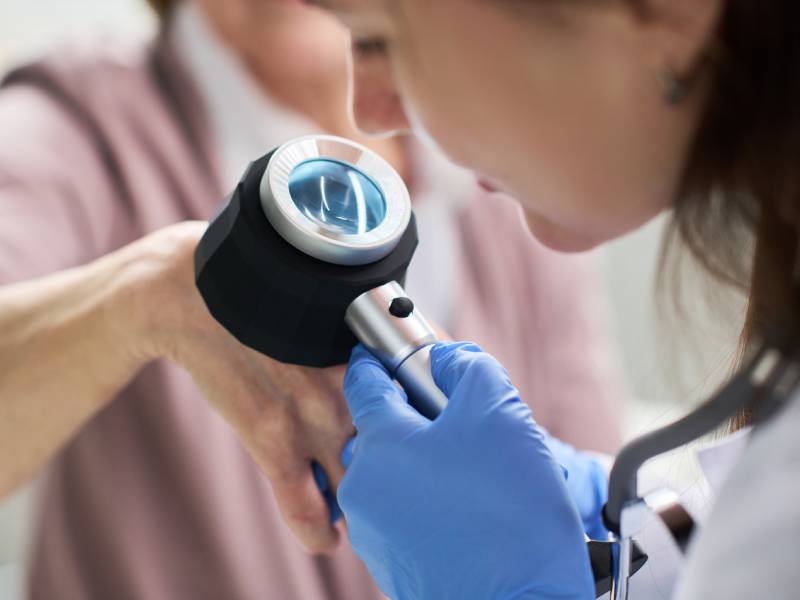
The dermatologist asks how long you have had the mole, whether it has changed and about your risk factors, then examines the skin. Moles are often looked at with dermoscopy, a handheld magnifying lens with special light that shows patterns not visible to the naked eye. Most moles need nothing more than this check.
If a mole looks suspicious, the doctor may recommend removing it and sending it to the laboratory for analysis, which gives the definite answer. At Aura, the removal of moles and other skin growths is planned after assessment and performed in the Day Hospital. Do not try to remove a mole yourself with creams, freezing kits or other home methods: this can leave a scar and makes later analysis impossible.
Protecting your skin
- Seek shade in the middle of the day, when the sun is strongest, roughly from 11:00 to 16:00.
- Wear clothing that covers the skin, a wide-brimmed hat and sunglasses.
- Use a broad-spectrum sunscreen with SPF 30 or higher, and reapply it every 2 hours and after swimming.
- Avoid sunbeds.
- Protect children from sunburn, because sunburns in childhood raise the risk later in life.
When to see a doctor
- A new mole or spot, especially in adulthood.
- A mole that changes in size, shape or colour.
- A mole that bleeds, itches or crusts, or a sore that has not healed within about 4 weeks.
- A mole that looks different from all your other moles.
- A new dark line under a nail.
If a mole changes quickly or bleeds without a clear reason, book an appointment soon rather than waiting for a routine check.
Questions for your consultation
- Do any of my moles need closer monitoring?
- How often should my skin be checked?
- Should this mole be removed and analysed?
- If it is removed, what will the scar look like?
- How should I photograph my moles to compare them over time?
- Which sun protection suits my skin?
Read more about dermatology consultations at Aura Medical Clinic and the removal of skin growths. A consultation with Dr. Gloria Hoxhallari sets out your individual plan.