

Blood sugar can be checked in different ways: with a drop of blood from the fingertip, with a fasting blood sugar test in the laboratory, or with HbA1c, which shows the average of the last few months. Each test answers a different question, so the same word, “high”, means something different depending on which test you had.
At Aura Medical Clinic in Tirana, diabetes and prediabetes are assessed by endocrinologist Dr. Sara Zavalani, the clinic’s founder. This article compares the three tests: what each one measures, when it is used, what its limits are, how to prepare and what to do after a high result.
The three blood sugar tests at a glance
| What to compare | Finger-prick test | Fasting blood sugar | HbA1c |
|---|---|---|---|
| What it shows | Blood sugar at that moment | Blood sugar after a night without food | Average blood sugar over the last 2–3 months |
| Fasting | Not needed; the result is read according to when you last ate | Needed: at least 8 hours without food | Not needed |
| How it is done | A drop of blood from the fingertip, measured with a small meter; the result is ready in seconds | A blood sample from a vein, analysed in a laboratory | A blood sample from a vein, analysed in a laboratory |
| Main use | A quick check; daily self-monitoring for people with diabetes | Screening, diagnosis and follow-up | Screening, diagnosis and follow-up of diabetes |
| Diagnosis | Not on its own: a high value needs laboratory tests | Yes, when the result is confirmed | Yes, when the result is confirmed |
| Limits | Less precise than a laboratory test; changes with food, activity and stress | Varies from day to day; illness, stress and some medicines can raise it | Can be misleading in anaemia, thalassaemia trait, pregnancy, after blood loss or in kidney disease |
The three tests do not compete with each other. They complement each other, and the doctor decides which ones you need.
The finger-prick test: a quick check, not a diagnosis
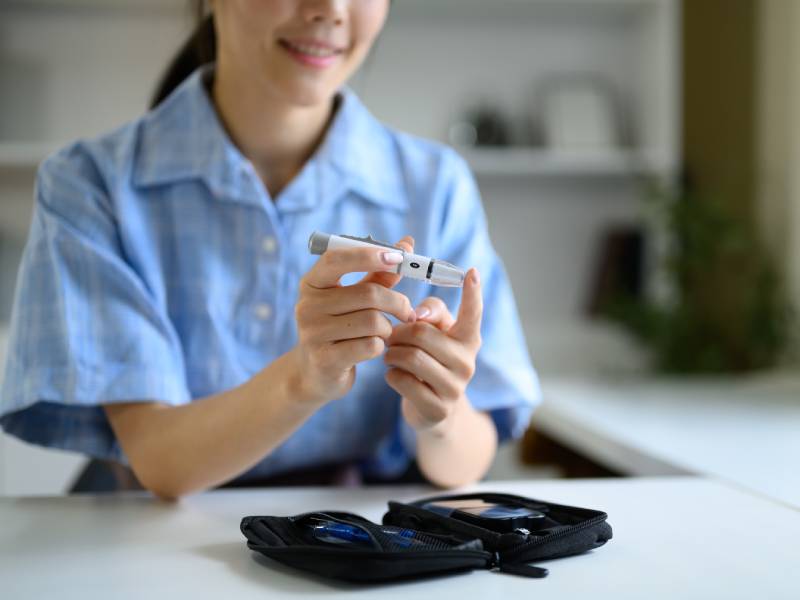
A finger-prick test measures the sugar in a drop of blood from the fingertip with a small portable meter. It is quick and simple, which is why it is used on screening days and by people with diabetes to check their blood sugar at home.
The result shows only that moment. It depends on when and what you last ate, on physical activity and on stress. Portable meters are also less precise than a laboratory analysis, so their result can differ from the laboratory value.
That is why a finger-prick value is a signal, not a diagnosis. A high value is a reason for laboratory tests, and a normal value at a single moment does not rule out prediabetes.
Fasting blood sugar: measured after a night without food
Fasting blood sugar (fasting glucose) is measured in a blood sample from a vein, after at least 8 hours without food. Because the test is always done under the same conditions, the result can be compared with standard thresholds.
Fasting blood sugar varies from one day to the next. A cold or a fever, severe stress and some medicines, such as cortisone-type medicines (corticosteroids), can raise it for a while. That is why a single high result is repeated or confirmed with another test.
HbA1c: the average of the last 2–3 months
HbA1c (glycated haemoglobin) shows how much of the haemoglobin in red blood cells has sugar attached to it. Red blood cells live for about three months, so HbA1c reflects the average blood sugar of the last 2–3 months, not of a single day. No fasting is needed, and a meal before the test does not change the result.
In people with diabetes, HbA1c is the main test for follow-up, usually every 3–6 months. It can be misleading when red blood cells have a shorter life or the haemoglobin is different: in anaemia, in thalassaemia trait or other haemoglobin variants, in pregnancy, after blood loss or a transfusion, and in advanced kidney disease. Thalassaemia trait is fairly common in Mediterranean countries, so tell the doctor if you know you carry it.
What the results mean
| Test | Normal | Prediabetes | Diabetes |
|---|---|---|---|
| Fasting blood sugar (glucose) | below 100 mg/dL (5.6 mmol/L) | 100–125 mg/dL (5.6–6.9 mmol/L) | 126 mg/dL (7.0 mmol/L) or higher |
| HbA1c (glycated haemoglobin) | below 5.7% | 5.7–6.4% | 6.5% or higher |
These are the thresholds commonly used in international guidelines. A diagnosis is not made from a single value: without clear symptoms, it needs two high results, either the same test repeated or two different tests. The doctor interprets the results together with your medical history.
Sometimes fasting blood sugar is normal while HbA1c is raised, or the other way round. Because the two tests measure different things, this can happen. The doctor usually repeats the test that was high, and may also suggest a glucose tolerance test.
A blood sugar of 200 mg/dL (11.1 mmol/L) or higher at any time of day, together with typical symptoms such as strong thirst and passing a lot of urine, points strongly to diabetes and needs a doctor’s assessment soon.
After a high finger-prick result
- Stay calm: a single high value is not a diagnosis.
- Do not start a strict diet or any medicine on your own.
- Ask the doctor which laboratory tests you need: usually fasting blood sugar, HbA1c or both.
- Bring the finger-prick result and any earlier results to the consultation.
- If the tests confirm prediabetes or diabetes, the endocrinologist explains the next steps: diet, physical activity, weight and, when needed, medication.
A normal finger-prick value is reassuring for that moment. If you have risk factors, such as being over 35, being overweight, having diabetes in the family or having had diabetes in pregnancy, a laboratory test is still worth doing. The early signs and all the risk factors are covered in Dr. Sara Zavalani’s article Type 2 diabetes: early signs and when to get tested.
How to prepare for a fasting blood sugar test
- Do not eat for at least 8 hours before the test. The easiest way is an overnight fast and a morning appointment.
- Drink only water. Coffee, tea, juice, milk and chewing gum can change the result.
- Avoid alcohol and an unusually heavy meal the evening before.
- If you take medicines, especially for diabetes, ask the doctor how to take them on the morning of the test.
- If you have a fever or another acute illness, tell the laboratory; it may be better to postpone the test.
HbA1c needs no special preparation. If you have both tests, a single blood draw in the morning, while fasting, is enough.
When to seek help straight away
Very strong thirst with passing a lot of urine, vomiting, abdominal pain, fast breathing, drowsiness or confusion need immediate medical help. In these cases, do not wait for a test or an appointment: go to an emergency department.
Questions for your consultation
- Which test do I need, and why?
- How should I read my finger-prick result?
- Do my fasting blood sugar and HbA1c agree, and if not, what happens next?
- Could anything affect my HbA1c result, for example anaemia or thalassaemia trait?
- Should I take my usual medicines before a fasting test?
- When should I repeat the tests?
Read more about endocrinology at Aura Medical Clinic. Blood sugar and HbA1c can be measured at Aura’s laboratory, and a consultation with Dr. Sara Zavalani sets out your individual plan.